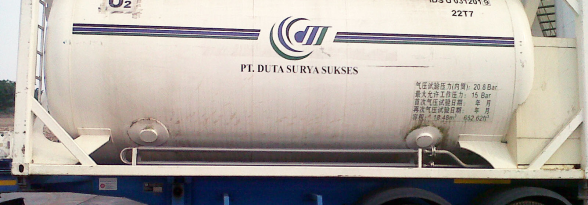


Liquid Oxygen
Oxygen is the second largest component of the atmosphere, comprising 20.8% by volume. Liquid oxygen is pale blue and extremely cold. Although nonflammable, oxygen is a strong oxidizer. Oxygen is necessary to support life.
Oxygen exhibits reactivity with nearly all organic materials and metals, typically resulting in oxide formation. Substances that combust in normal air will ignite more intensely in the presence of oxygen. Equipment intended for oxygen service must adhere to rigorous cleanliness standards, and systems must be fabricated from materials with high ignition temperatures that remain non-reactive with oxygen throughout operational conditions.
Liquid oxygen is classified as a cryogenic liquid, defined as liquefied gases with a normal boiling point below -238°F (-150°C). Specifically, liquid oxygen has a boiling point of -297.3°F (-183.0°C).
Due to the significant temperature differential between the product and its surrounding environment, effective insulation is crucial for maintaining liquid oxygen’s integrity. Handling and storage of the product necessitate specialized equipment to ensure safety and operational efficiency.
Oxygen is commonly stored in liquid form, despite being predominantly utilized as a gas. Liquid storage offers a more space-efficient and cost-effective solution compared to storing the equivalent capacity in high-pressure gas form.
A typical storage system comprises a cryogenic storage tank, one or more vaporizers, a pressure control system, and complete piping infrastructure for filling, vaporization, and supply functions.
The cryogenic tank is designed similar to a thermos bottle, featuring an inner vessel enclosed within an outer vessel. Between these vessels lies an annular space filled with a vacuum-insulated material, purged of all air.
This insulated space effectively insulates the inner vessel, maintaining the temperature of the liquid oxygen. Vaporizers are employed to convert the liquid oxygen into its gaseous state. Subsequently, a pressure control manifold regulates the gas pressure supplied to the intended process or application.